
What Is an ATS Resume Score? A Complete Guide to Understanding ATS Scores
An ATS resume score is intended to show how well a resume aligns with the criteria being analysed by an applicant tracking or resume-screening system. But what does the number actually mean? Learn what affects an ATS score, how ATS resume checkers analyse applications, what a good score means, and why the score should be treated as a diagnostic tool rather than a guarantee of an interview.

An ATS resume score is a numerical or analytical indication produced by a particular resume-screening or resume-analysis system. It may reflect factors such as job-description alignment, relevant skills, keywords, experience, qualifications, formatting, and other criteria used by that system.
There is no single universal ATS scoring system that makes every score directly comparable. The most useful way to interpret an ATS score is to understand what produced it, identify the areas that need attention, and use the findings to improve the resume for the specific opportunity.
What Is an ATS Resume Score?
An ATS resume score is a score or assessment generated by an applicant-tracking or resume-analysis system to indicate how closely a resume meets the criteria being evaluated.
The exact meaning of the score depends on the system producing it.
Some resume checkers may focus heavily on keywords and formatting. Others may compare a resume with a job description and analyse skills, experience, qualifications, terminology, and other forms of relevance.
This means that an ATS score should not be treated as a universal measurement like a percentage on a standardised examination.
An ATS score is useful when it helps you understand how your resume is performing against defined criteria. The explanation behind the score is usually more valuable than the number itself.
What Is an Applicant Tracking System?
An Applicant Tracking System, commonly called an ATS, is software used by organisations and recruitment teams to manage aspects of the hiring process.
Depending on the system and how an employer uses it, an ATS can support activities such as collecting applications, organising candidate information, managing recruitment workflows, and helping recruiters search or review applicant data.
This is why ATS-friendly resume design matters.
Your resume needs to communicate information clearly in a format that can be processed effectively, while also remaining useful to the people reviewing it.
However, it is important not to think of an ATS as one universal machine with one universal algorithm.
Different employers use different recruitment technologies and configure their systems differently.
How Is an ATS Resume Score Calculated?
There is no single formula used to calculate every ATS resume score.
Resume-analysis platforms can use different criteria and methods to assess a document.
A job-specific resume checker may consider several dimensions, such as:
- The requirements contained in the job description
- Relevant technical and professional skills
- Experience alignment
- Job-related terminology
- Qualifications and certifications
- Evidence of relevant responsibilities
- Potentially missing requirements
- Resume structure and formatting
The resulting score is therefore a summary of the particular analysis performed by that system.
Two different resume checkers can analyse the same resume and produce different scores because their criteria and methodologies may differ.
What Factors Can Affect an ATS Score?
Several factors can influence how a resume performs in an ATS-oriented analysis.
1Job-Relevant Skills
If the target opportunity requires particular technical, professional, or functional skills, your resume should clearly demonstrate the skills you genuinely possess.
2Experience Alignment
The relevance of previous roles and responsibilities can affect how closely your resume aligns with the target position.
3Keywords and Terminology
Job-related terminology can help communicate that your experience corresponds with the language used in the opportunity.
4Qualifications
Education, certifications, licences, professional qualifications, or other requirements may be relevant depending on the role.
5Resume Structure
Clear organisation and consistent sections can make important information easier to identify and process.
6Evidence
Demonstrating how you have actually used a skill can be more informative than simply listing that skill.
Why ATS Scores Can Change for Different Jobs
One of the most important things to understand about resume scoring is that your resume does not exist in a vacuum.
Consider a professional with experience in IT support, systems administration, Microsoft technologies, networking, and user support.
That resume might be highly relevant to an IT Support Specialist vacancy.
But the same resume could have a different level of alignment with a cybersecurity position that places greater emphasis on security monitoring, threat detection, incident response, vulnerability management, or security tooling.
The candidate has not changed.
The requirements have changed.
A resume score should ideally help you understand the relationship between your current profile and the particular opportunity you are pursuing.

What Is a Good ATS Score?
There is no universal ATS score that guarantees an interview.
You may encounter websites or tools that describe particular numerical thresholds as “good” or “excellent.” Those thresholds are specific to the scoring methodology being used and should not automatically be treated as a universal recruitment standard.
Instead of asking only whether your score is high enough, ask what the score reveals about your application.
A score such as 80 is meaningful only when you understand what the system evaluated and what the remaining 20 points represent.
If the remaining gap is caused by a genuinely missing mandatory qualification, that information may be more important than simply increasing the number.
If the gap is caused by experience that you already possess but have not clearly described, the appropriate action may be to improve the resume rather than develop a new skill.
The diagnosis matters.
Why the Number Alone Is Not Enough
Imagine that an ATS resume checker gives you a score of 68.
That number alone does not tell you what to change.
You need to know why the result was 68.
Consider two possible explanations.
You already have the required experience, but the resume does not clearly describe it.
The target role requires a technology you have never used and your resume contains no credible evidence of that capability.
Both situations could contribute to a lower score, but the correct response is completely different.
In Scenario A, you may need to improve how your experience is communicated.
In Scenario B, you may need to develop the capability itself.
- What is missing or weak?
- Why does it matter for this opportunity?
- What should I do next?
How Keywords Affect ATS Resume Scores
Keywords are often discussed when people talk about ATS scores.
Job descriptions naturally contain terminology associated with the role, and using accurate terminology in your resume can make relevant experience easier to recognise.
However, keyword optimisation should not become keyword stuffing.
Consider the difference between these approaches.
Microsoft 365, Azure, Active Directory, Azure, Microsoft 365, networking, Azure, Microsoft 365, Active Directory.
Supported Microsoft 365 users, administered Active Directory accounts and access, and diagnosed endpoint and network connectivity issues across business environments.
The second approach gives context to the terminology.
Your resume should demonstrate genuine experience rather than simply attempting to maximise keyword frequency.
How Resume Formatting Can Affect ATS Analysis
Resume formatting can affect how easily information is interpreted.
A practical ATS-friendly resume should generally prioritise clarity and structure over unnecessarily complicated design.
Review areas such as:
- Section headings
- Job titles
- Employment dates
- Education and certification sections
- Bullet-point structure
- Font readability
- Consistent formatting
- Logical document organisation
The objective is not to make your resume visually unattractive.
A professionally designed resume can still be clean, modern, and easy to process.
The important principle is that visual design should support the information rather than obscure it.
Skills, Experience and Qualifications
A resume score can become much more meaningful when you consider the relationship between skills and evidence.
Suppose a job requires:
- Microsoft 365
- Active Directory
- Endpoint support
- Network troubleshooting
- IT service management
Simply placing these terms in a skills section is not necessarily enough to demonstrate capability.
Your employment history should ideally provide evidence that you have actually used relevant capabilities.
IT service management
Managed and prioritised user incidents through an IT service-management workflow, documenting troubleshooting steps, escalating complex issues, and maintaining accurate resolution records.
The second example provides much more context about what the candidate actually did.
What Missing Requirements Can Tell You
One of the most valuable parts of resume analysis can be discovering what is not present.
A missing requirement should not automatically be interpreted as a reason to abandon an application.
Instead, investigate the nature of the gap.
This distinction can turn a resume score from a simple number into useful career intelligence.
ATS Score vs Resume Score
The terms “ATS score” and “resume score” are sometimes used interchangeably online, but they can describe different types of analysis.
Always check what a particular platform means when it uses the term “score.”

How to Improve Your ATS Resume Score
If your ATS resume score indicates that your resume could be better aligned with a target opportunity, use the analysis to guide specific improvements.
1. Start with the target job
Understand the actual requirements rather than optimising your resume in isolation.
2. Identify important requirements
Extract the skills, responsibilities, qualifications, technologies, and competencies that matter most.
3. Strengthen relevant experience
Make your most relevant responsibilities and achievements easier to identify.
4. Improve weak descriptions
Replace vague statements with clearer evidence of what you did and the value or outcome of your work.
5. Use accurate terminology
Where your experience genuinely corresponds with terminology in the vacancy, make that relationship clear.
6. Address genuine gaps
If an important capability is genuinely missing, consider whether training, certification, projects, or additional experience could help develop it.
7. Recheck the resume
After making appropriate changes, analyse the resume again against the same opportunity.
A higher number is not useful if it has been achieved by adding skills you do not possess, exaggerating experience, or filling the document with irrelevant keywords.
ATS Score Mistakes to Avoid
Chasing a perfect score
No score can capture every factor involved in recruitment. Treat the number as a diagnostic signal rather than an absolute target.
Adding every keyword
Repeating terminology without evidence can make a resume less natural and less credible.
Claiming skills you do not have
Never add qualifications or technical capabilities simply because they appear in a job description.
Ignoring the job description
A generic resume score may tell you something about your document, but job-specific alignment requires understanding the actual opportunity.
Ignoring genuine skill gaps
Missing skills can be valuable career-development information. They can help you decide what to learn next.
Assuming ATS success equals interview success
Recruitment involves human decisions and many factors beyond automated resume analysis.
How GekelEdge Uses Job-Specific Resume Intelligence
GekelEdge approaches resume scoring as part of a broader career intelligence process.
The purpose is not simply to tell a candidate whether their resume has a high or low number.
The objective is to help answer:
This approach connects several layers of analysis.
1Resume Intelligence
Understand the candidate’s existing experience, skills, qualifications, achievements, and professional positioning.
2Target Job Intelligence
Analyse the requirements and expectations associated with the selected opportunity.
3Alignment Analysis
Compare the candidate’s resume with the target job to identify areas of strong and weak alignment.
4Skill Gap Intelligence
Distinguish between missing information, transferable capabilities, weakly represented skills, and genuine skill gaps.
5Career Action
Turn the analysis into practical improvement actions rather than stopping at a numerical score.
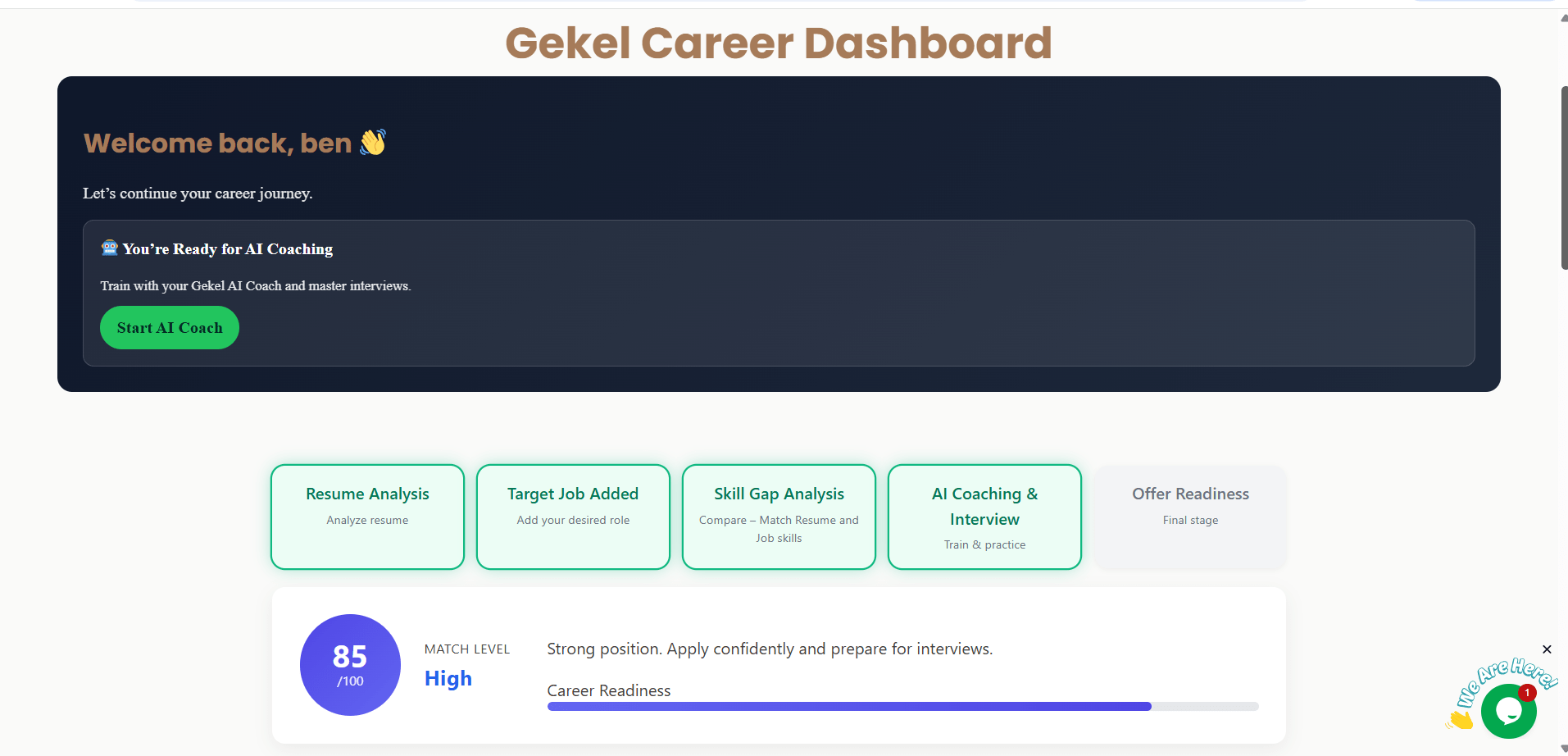
This creates a more useful relationship between resume scoring and career development.
The score becomes the beginning of the conversation rather than the end of it.
When an ATS Score Is Not Enough
Sometimes the problem is not simply the resume.
You may be targeting the wrong type of role, changing careers, struggling to communicate transferable experience, repeatedly applying without interviews, or uncertain about how to position yourself in a competitive market.
In those situations, automated analysis can identify useful information, but personalised professional guidance may be needed to interpret the wider career challenge.
GekelEdge Career Services provides personalised support covering areas such as resume review, resume optimisation, career positioning, skill-gap assessment, interview preparation, and structured career action planning.
Explore Career ServicesATS Resume Score Checklist
Before relying on an ATS score, make sure you have considered the following:
Frequently Asked Questions
An ATS resume score is a numerical or analytical indication produced by a particular resume-screening or resume-analysis system. It may reflect factors such as job alignment, skills, keywords, experience, qualifications, and resume structure.
There is no universal ATS score that guarantees an interview. Different resume analysis systems can use different scoring methods, so the most useful approach is to understand what the score represents and what the underlying analysis recommends improving.
Not necessarily. A job-specific resume analysis can produce different results for different opportunities because each job has its own requirements, skills, responsibilities, and terminology.
You can use an online ATS or resume analysis tool. Where possible, provide the actual job description as well as your resume so that the analysis can evaluate job-specific alignment.
No. An ATS score is an analytical indicator and cannot account for every factor involved in recruitment, including candidate competition, employer preferences, interview performance, and other hiring considerations.
Relevant terminology can help communicate alignment, but adding irrelevant or unsupported keywords is not a sound optimisation strategy. Keywords should accurately represent your genuine skills and experience.
Different jobs have different requirements. A resume may align strongly with one role and less strongly with another because the required skills, experience, qualifications, and responsibilities differ.
The terms can overlap, but they do not necessarily describe identical analyses. Always check what criteria the particular platform uses when calculating its score.
Review the reasons behind the score. Check your job alignment, skills, experience, qualifications, terminology, evidence, formatting, and missing requirements. Then make accurate improvements and reassess the resume where appropriate.
A perfect numerical score should not be the objective. The more useful goal is to create an accurate, relevant, well-structured resume that clearly demonstrates your genuine suitability for the opportunity.
Understand Your Resume Before You Apply
An ATS score can give you a useful signal, but the real value comes from understanding what is behind the number.
GekelEdge helps you analyse your resume in the context of the opportunity you are pursuing, identify alignment and gaps, and understand what actions can strengthen your application.
Check Your ResumeConclusion
An ATS resume score can be a useful way to identify potential weaknesses in an application, but the number should never be viewed in isolation.
There is no universal ATS scoring formula that makes every score directly comparable. Different systems can assess different factors and use different methodologies.
What matters most is understanding what the analysis reveals about your resume.
Are your relevant skills visible? Does your experience demonstrate the responsibilities required by the role? Are important qualifications clearly presented? Does your terminology accurately communicate your capabilities? Are there genuine skill gaps that you need to address?
Most importantly, evaluate your resume against the specific opportunity you want.
A resume that is well aligned with one role may require significant changes for another. That is not necessarily a problem—it is a reflection of the fact that different opportunities require different combinations of skills, experience, and evidence.
The most useful ATS score is therefore not simply a number.
It is a starting point for understanding your competitiveness, identifying what needs attention, and deciding what to do next.