
Free ATS Resume Checker: How to Test Your Resume Before Applying
A free ATS resume checker can help you identify formatting problems, missing job-related terminology, weak alignment, and other issues before you submit an application. But an ATS check is most useful when you understand what the result actually measures and what you should do next.

A free ATS resume checker can be useful for identifying potential problems before you apply, particularly when it evaluates your resume against a specific job description. The most useful checks go beyond formatting and keyword counting to examine job requirements, skills, experience, terminology, and missing areas of alignment.
The key is to treat the result as diagnostic information rather than a guarantee of interview success. A score tells you that something may need attention; the analysis should tell you what that something is and what action to take.
What Is a Free ATS Resume Checker?
An ATS resume checker is an online tool designed to analyse a resume for factors that may affect how well it can be processed by an applicant tracking system and how closely it aligns with a particular job.
“ATS” stands for Applicant Tracking System. Employers and recruiters may use applicant tracking technology to help organise applications and manage recruitment workflows.
An ATS resume checker attempts to simulate or assess some aspects of that screening environment.
Depending on the tool, it may analyse:
- Resume formatting
- Section headings
- Skills
- Keywords and terminology
- Work experience
- Qualifications
- Job-description alignment
- Potentially missing requirements
- Resume structure and readability
A free ATS resume checker can therefore be useful as an early diagnostic step before submitting an application.
An ATS checker is not the employer, and an ATS score is not an interview decision. It is an analytical signal that can help you identify areas worth reviewing.
Why Use an ATS Resume Checker Before Applying?
Applying for a job without checking your resume against the opportunity can mean missing problems that could have been corrected beforehand.
For example, you may have relevant experience but fail to describe it in a way that makes the relevance obvious.
You may also have:
- A poorly structured resume
- Important skills buried in unrelated sections
- Missing job-specific terminology
- Weak descriptions of relevant experience
- Insufficient evidence of important responsibilities
- Formatting that makes information harder to process
- Genuine skill gaps that you had not previously identified
Running an ATS check before applying gives you an opportunity to identify and address these issues rather than discovering them after submitting the application.
What Does an ATS Resume Checker Check?
Different tools use different methods, so there is no single universal ATS score or identical checklist used by every resume checker.
However, a useful ATS-oriented analysis can examine several important areas.
This distinction is important because a resume can be technically ATS-friendly while still being poorly aligned with the particular job.
How to Use a Free ATS Resume Checker
The process is usually straightforward, but the quality of the result depends heavily on how you use the tool.
1Prepare Your Resume
Use the version of your resume that you are actually considering submitting. If you have a master resume and a targeted version, analyse the version intended for the application.
2Identify the Target Job
Know exactly which role you are applying for. The same resume may perform differently against different opportunities because the requirements are different.
3Add the Job Description
Where the checker supports job-description analysis, provide the full vacancy description rather than relying only on the job title.
4Run the Analysis
Review the score and, more importantly, examine the underlying findings.
5Understand the Gaps
Determine which problems relate to formatting, which relate to job alignment, which are representation issues, and which are genuine skill gaps.
6Improve and Recheck
Make accurate improvements and run the analysis again if appropriate.
Why You Should Include the Job Description
This is one of the most important differences between a generic resume checker and a job-specific resume analysis.
A generic checker may tell you that your resume contains certain skills or has particular formatting characteristics.
But that does not necessarily tell you whether those skills are the ones required for your target role.
Consider a candidate with experience in:
- Microsoft 365
- Active Directory
- Hardware troubleshooting
- Networking
- Helpdesk support
- Customer service
A generic resume check might identify those as useful technical capabilities.
But suppose the target vacancy specifically emphasises:
- Azure administration
- PowerShell
- Intune
- Endpoint management
- Microsoft Entra ID
The candidate’s general resume quality has not changed. The target opportunity has.
This is why job-specific analysis provides a different kind of information from a generic resume review.
A generic resume checker asks, “How does this resume look?”
A job-specific checker asks, “How well does this resume demonstrate relevance to this particular opportunity?”

What Does an ATS Resume Score Mean?
An ATS resume score is usually intended to summarise how well a resume meets the criteria being evaluated by a particular resume analysis system.
However, there is no universal ATS scoring standard that means every score from every tool should be interpreted in exactly the same way.
One platform’s score of 80 may not represent exactly the same analysis as another platform’s score of 80.
That means the number itself should never be considered the entire answer.
Instead, ask:
- What factors produced this score?
- Which requirements am I matching?
- Which requirements are weakly represented?
- Which requirements appear to be missing?
- Are there formatting concerns?
- Are my achievements strong enough?
- Does my experience clearly demonstrate the required capabilities?
- What should I change before applying?
What Is a Good ATS Score?
There is no universal ATS score that guarantees that a resume will pass an employer’s screening process or result in an interview.
Online resume tools may use different scoring systems, criteria, datasets, or algorithms.
Therefore, a score should be treated as a diagnostic indicator within the specific system that generated it.
If increasing your score requires adding irrelevant keywords, repeating terminology unnaturally, or claiming experience you do not have, the score is no longer helping you produce a better application.
The more useful objective is to improve the genuine alignment, clarity, evidence, and accuracy of your application.
ATS Resume Formatting Checks
Formatting matters because your resume needs to communicate information clearly to both technology and human readers.
When reviewing ATS compatibility, pay attention to:
- Clear section headings
- Consistent formatting
- Readable fonts
- Logical chronology
- Clear job titles
- Simple document structure
- Consistent dates
- Readable contact information
- Appropriate use of bullet points
The objective is not to make every resume visually identical. The objective is to ensure that the information is easy to interpret and that design choices do not obscure important content.
ATS Keywords: What You Should and Shouldn’t Do
Keywords are important in resume optimisation, but they should be used carefully.
Start by identifying the terminology that genuinely applies to your background.
If a job description asks for “Microsoft 365 administration” and you have performed that work, make sure your resume communicates it clearly.
But adding “Microsoft 365 administration” simply because it appears in the vacancy is not appropriate if you have never performed the work.
Adding a long list of job-description keywords without evidence that you possess those skills.
Using accurate job-relevant terminology within genuine examples of your experience, responsibilities, projects, and achievements.
A resume should be optimised for relevance, not manipulated to produce an artificial score.
Finding Missing Skills and Requirements
One of the most valuable functions of a job-specific ATS resume check is identifying areas where your resume does not demonstrate an important requirement.
But a missing item does not always mean you lack the capability.
Consider these three possibilities:
These situations should not be treated identically.
The first may require better resume wording.
The second may require clearer explanation of transferable experience.
The third may require learning, practical experience, certification, or a different career-development decision.
How to Improve Your Resume After an ATS Check
Once you have your results, resist the temptation to change everything at once.
Start with the issues that have the greatest relevance to the target role.
Improve your professional summary
Make sure the opening section quickly communicates your relevant professional identity and the type of value you bring.
Strengthen relevant experience
Make important responsibilities and achievements more visible.
Use accurate terminology
Where your experience genuinely corresponds with terminology in the job description, use clear language that allows the relationship to be recognised.
Improve achievement evidence
Wherever possible, explain what you did, how you did it, and what changed as a result.
Address representation gaps
If you already have the required experience but your resume does not demonstrate it, improve the way that experience is presented.
Address genuine skill gaps
Do not manufacture experience. Instead, consider realistic ways to develop the missing capability.
Remove irrelevant information
A targeted resume should prioritise information that helps demonstrate relevance to the opportunity.

Limitations of Free ATS Resume Checkers
Free resume checkers can be useful, but they should be used with realistic expectations.
No automated checker can completely reproduce the hiring process.
An actual recruitment decision can involve many factors that are not represented by a resume score.
For example:
- The number of candidates applying
- The employer’s internal priorities
- The hiring manager’s preferences
- Candidate experience level
- Interview performance
- Location and working arrangements
- Salary expectations
- Internal candidates
- Timing within the recruitment process
- Other qualifications or circumstances
A resume checker can therefore help you improve your application, but it cannot guarantee what an employer will ultimately decide.
Use an ATS checker to reduce avoidable problems and improve relevance. Do not use it as a promise of interview success.
How GekelEdge Goes Beyond a Basic ATS Check
GekelEdge takes a broader approach to resume analysis because the goal is not simply to produce an ATS number.
The platform is designed around the relationship between the candidate, the resume, and the target career opportunity.
1Resume Intelligence
Understand the candidate’s existing skills, experience, qualifications, achievements, and professional profile.
2Target Job Intelligence
Analyse the requirements of the specific job the candidate wants to pursue.
3Job-Specific Alignment
Compare the candidate’s resume with the target opportunity rather than treating the resume as a generic document.
4Skill Gap Intelligence
Identify important requirements that are strongly matched, weakly represented, transferable, or genuinely missing.
5Career Action
Turn the findings into practical next steps, from resume improvements and skill development through to interview preparation.
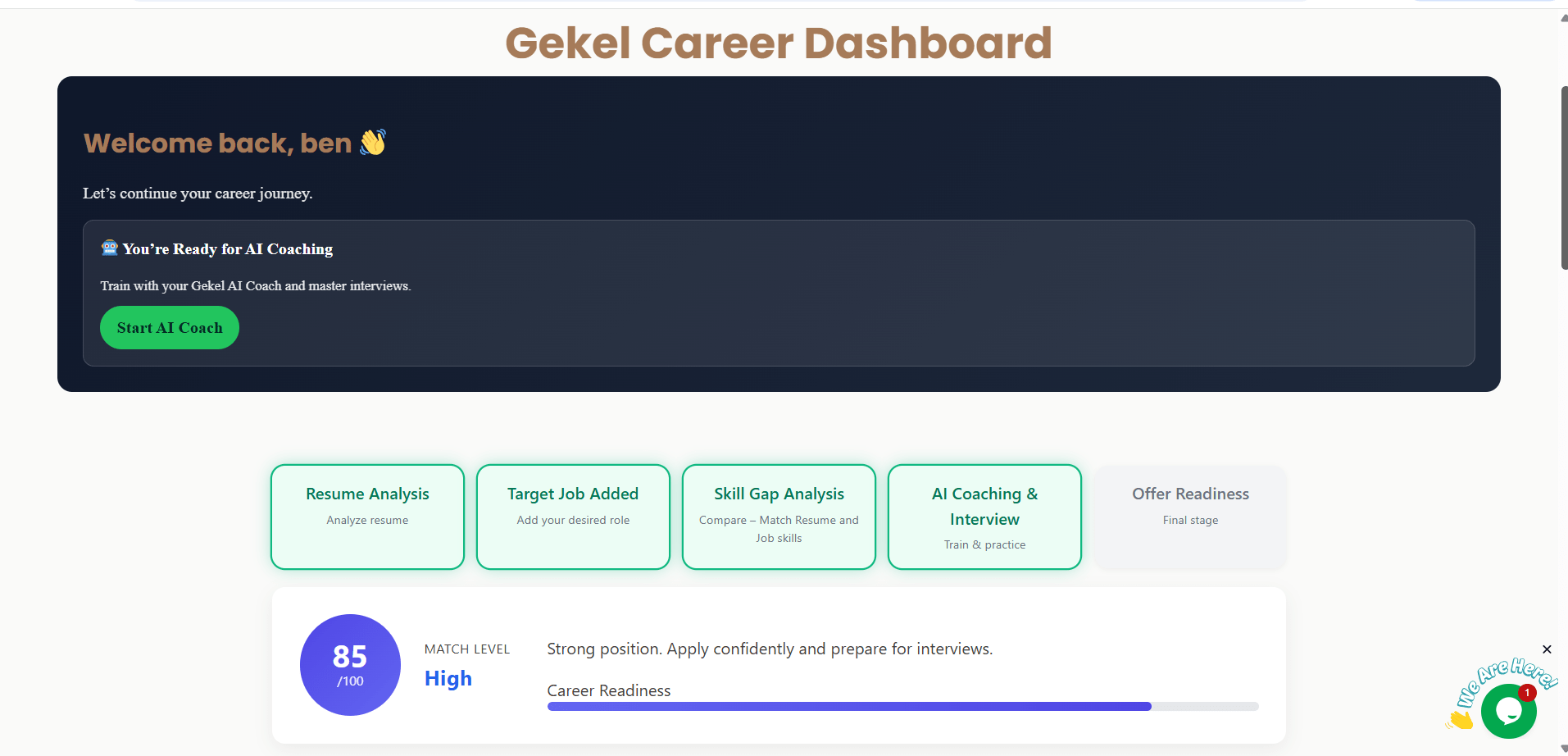
This creates a broader question than simply asking whether a resume is ATS-friendly.
The question becomes: How well does this candidate’s current profile align with the opportunity, what is holding the application back, and what should happen next?
When a Free Resume Checker Is Not Enough
Automated analysis can provide useful information, but there are situations where professional career guidance can add another layer of value.
This can be particularly relevant if you are changing careers, moving into a more senior position, struggling to position transferable experience, repeatedly applying without receiving interviews, or uncertain about the type of role you should target.
GekelEdge Career Services combines professional review with career strategy, resume optimisation, skill-gap assessment, interview preparation, and personalised action planning.
If your challenge goes beyond fixing a document, explore the personalised support available through GekelEdge Career Services.
Explore Career ServicesFree ATS Resume Checker Checklist
Before submitting your application, use this checklist alongside your ATS analysis.
Frequently Asked Questions
A free ATS resume checker is an online tool that analyses a resume for factors related to applicant tracking systems and, in some cases, compares the resume with a specific job description.
It can be useful for identifying potential formatting, keyword, skills, experience, and job-alignment issues before submitting an application. The value depends on the quality and relevance of the analysis rather than simply whether the tool is free.
Some online services provide free ATS or resume analysis. However, different services use different scoring methods, so scores should be interpreted according to the criteria used by the particular tool.
Yes. Job-specific analysis can reveal requirements and skills that may not be obvious when reviewing your resume on its own.
Review why the score is low. Look for missing requirements, weak job alignment, unclear experience, terminology gaps, formatting concerns, or genuine skill gaps. Then make accurate improvements and reassess the resume.
No. A resume score cannot account for every factor involved in recruitment and should not be treated as a guarantee of interview success.
Only when the keywords accurately describe your experience and are relevant to the role. Adding irrelevant or unsupported keywords can make a resume less credible.
The terminology varies between services. An ATS-focused checker generally emphasises compatibility and screening-related factors, while a broader resume checker may also assess writing, structure, job alignment, achievements, and overall resume quality.
A job-specific analysis may identify requirements that are not clearly represented in your resume. You should then determine whether each apparent gap is a missing skill, transferable experience, or simply an experience that needs to be presented more clearly.
Test Your Resume Before You Apply
Don’t wait until after submitting an application to discover that your resume does not clearly communicate your relevance to the role.
GekelEdge helps you analyse your resume in the context of the opportunity you’re pursuing, so you can understand your alignment, identify important gaps, and take action before applying.
Check Your ResumeConclusion
A free ATS resume checker can be a useful part of your job application process, particularly when it allows you to compare your resume with the actual job description.
But the score itself is only one part of the picture.
The more important questions are what the analysis found, why those issues matter for the target role, and what you can realistically do about them.
Check your formatting. Review your skills. Examine your experience. Identify important terminology. Look for missing requirements. Most importantly, distinguish between skills you genuinely lack and experience that simply has not been communicated clearly.
And remember that the objective is not to manufacture the highest possible ATS score.
The objective is to create an accurate, relevant, evidence-based resume that clearly communicates your suitability for the opportunity you are pursuing.