
How to Check Your Resume Score Online: What a Good Resume Score Really Means
A resume score can help you understand how strong your resume is before you apply for a job. But not every resume score measures the same things. Learn how to check your resume score, understand what the result means, and use it to make your resume more competitive.

How can you check your resume score?
You can check your resume score by using a resume checker or resume analysis tool that evaluates your document against factors such as ATS compatibility, relevant skills, keywords, experience, structure and alignment with a target job. The most useful score is not simply a number. It should help you understand why your resume received that score and what you can improve before applying.
What Is a Resume Score?
A resume score is a numerical assessment designed to give you an indication of how well your resume performs against a defined set of criteria.
Depending on the tool you use, those criteria may include resume structure, formatting, keywords, skills, experience, readability, ATS compatibility, or alignment with a particular job description.
This is why two different resume checkers can sometimes give the same resume different scores. They may be evaluating different characteristics or using different scoring models.
More importantly, a resume should not always be evaluated in isolation. A strong resume for one position may be considerably less competitive for another.
For example, imagine that a candidate has strong experience in IT support, Microsoft 365, networking and user administration. Their resume could perform very well for a Service Desk Analyst position.
The same resume might receive a weaker result for a Cybersecurity Analyst position if the target role requires security monitoring, incident response, SIEM platforms and threat analysis that are not sufficiently represented in the resume.
The candidate has not necessarily become less qualified overnight. The relationship between the candidate’s experience and the target opportunity has changed.
How to Check Your Resume Score Online
Checking your resume score online should be more than uploading a document and looking at a number. A useful resume analysis should give you enough information to understand where your resume is strong, where it is weak and what action you should take next.
A practical resume scoring process usually looks something like this:
1. Upload your current resume
Start with the version of your resume you are actually planning to use. Avoid analysing an old version and assuming the result applies to the document you intend to submit.
2. Identify the target role
If you are applying for a specific position, provide the job description whenever the resume checker supports it.
This is important because employers do not evaluate candidates against a generic definition of “good experience.” They are hiring for a particular role with particular requirements.
3. Analyse your resume
The analysis may evaluate areas such as formatting, structure, keywords, skills, experience and relevance.
4. Review the score and underlying findings
Do not stop at the headline number. Look at the factors contributing to the result.
5. Make targeted improvements
Use the recommendations to improve the resume without simply adding every keyword you can find. Your resume should remain accurate, readable and representative of your actual experience.
What Is a Good Resume Score?
One of the first questions people ask after using a resume checker is simple: “Is my resume score good enough?”
The answer is more nuanced than a single number. There is no universal resume score that guarantees an interview, because different tools measure different factors and different jobs have different requirements.
A score can be useful as a benchmark, but its real value comes from understanding what is behind the score.
For example, a resume that receives a high overall score may still have weaknesses in areas that matter for a particular application. Conversely, a resume with a moderate score may contain strong experience that could become much more competitive after targeted improvements.
Think of the score as a diagnostic, not a verdict
A resume score should help answer questions such as:
- Does my resume clearly communicate my experience?
- Does it contain relevant skills for my target role?
- Is the document structured in a way that can be processed effectively?
- Does my experience align with the opportunity?
- Are important requirements missing or underrepresented?
- What should I improve before submitting my application?
This is much more useful than simply trying to reach an arbitrary number.
The goal is not to chase the highest possible score. The goal is to make your resume as relevant, credible and competitive as possible for the job you actually want.
Why Your Resume Score Can Change for Different Jobs
This is one of the most important things to understand about resume scoring.
Your resume does not exist in a vacuum. Its effectiveness depends partly on how well your experience and skills align with the opportunity you are pursuing.
That means the same resume can produce different results when evaluated against different job descriptions.
Consider this example
Imagine a candidate with several years of experience supporting users, managing Microsoft 365 environments, troubleshooting Windows devices, administering user accounts and resolving networking problems.
They apply for a:
- Service Desk Analyst position
- Microsoft 365 Support Specialist position
- Cybersecurity Analyst position
The candidate may be strongly aligned with the first two opportunities but less aligned with the third.
The difference is not necessarily the quality of the candidate. The difference is the relationship between the candidate’s existing experience and the requirements of each role.
Job descriptions change the evaluation
A job description can contain requirements relating to specific technologies, qualifications, skills, responsibilities, industries, levels of experience and business environments.
When those requirements change, the characteristics that make a resume relevant can change as well.
This is why a resume checker that allows you to compare your resume with a specific job description can provide more useful insight than a generic resume assessment alone.
Instead of asking only: “Is my resume good?”
You can ask a much more useful question: “How well does my resume position me for this particular opportunity?”

Resume Score vs ATS Score: What’s the Difference?
The terms resume score and ATS score are often used interchangeably online, but they do not necessarily mean the same thing.
An ATS, or Applicant Tracking System, is software employers may use to help manage and organise job applications. Depending on the system and employer, resumes can be processed, searched, filtered or ranked according to information contained in the application.
An ATS-focused assessment therefore tends to concentrate on whether your resume is compatible with automated processing and whether relevant information can be identified effectively.
A broader resume score may evaluate additional factors, such as the strength of your experience, relevance of skills, clarity of your achievements and alignment with a particular role.
ATS compatibility is important — but it is not everything
A technically compatible resume can still be weak from a hiring perspective.
For example, a resume may contain relevant keywords but fail to demonstrate meaningful achievements. It may mention a technology without explaining how the candidate used it. It may also contain the right terminology while presenting a career history that does not clearly support the target position.
On the other hand, a strong professional resume can still have problems if its formatting makes important information difficult for automated systems to process.
The strongest approach considers both sides: technical compatibility and genuine job relevance.
What Should a Resume Score Actually Measure?
There is no single formula that every resume checker uses. However, a meaningful resume analysis should examine several important dimensions rather than treating the document as a collection of keywords.
1. ATS compatibility
The resume should use a clear, structured format that allows important information to be identified and interpreted effectively.
2. Job and skill alignment
Your resume should communicate the skills and capabilities that are genuinely relevant to your target position.
3. Experience relevance
Employers need to understand not only where you have worked, but why your previous experience makes you suitable for the role you are pursuing.
4. Achievement strength
Strong resumes go beyond listing responsibilities. They demonstrate contribution, outcomes, improvements, scale or measurable results wherever appropriate.
5. Keyword and terminology alignment
Relevant terminology can help your resume communicate clearly with both automated systems and human reviewers. The emphasis should be on accurate and natural usage, not simply repeating keywords.
6. Missing or underrepresented requirements
A useful analysis should help identify important requirements that are absent, weakly represented or unclear in your resume.
7. Overall positioning
Ultimately, your resume should tell a coherent professional story: who you are, what you can do, what you have achieved and why you are relevant to the opportunity.
Why a High Resume Score Does Not Guarantee an Interview
One of the biggest misunderstandings about resume scoring is the idea that a high score automatically means an interview is coming.
It does not.
A resume score is an assessment tool. It can identify areas of strength and opportunities for improvement, but it cannot control every factor involved in a hiring decision.
Employers may consider many things beyond the content of a resume, including the candidate pool, required qualifications, experience level, location, availability, salary expectations, internal hiring processes and the specific priorities of the hiring team.
A high score can still hide important weaknesses
Consider a resume that performs strongly against a job description because it contains many relevant skills and terms.
If the document does not clearly demonstrate how the candidate has applied those skills, however, the resume may still be less persuasive to a human recruiter or hiring manager.
For example, simply stating that you have experience with Microsoft 365 is less informative than explaining what you actually did with that environment and what your work achieved.
The difference is between mentioning a capability and demonstrating capability.
A resume score should therefore be the beginning of the process
The most useful question after receiving a score is not:
“How do I make this number higher?”
A better question is:
“What does my resume need to communicate more effectively for this particular opportunity?”
How to Improve Your Resume Score
Improving your resume score should not mean stuffing the document with keywords or rewriting your career history to match every sentence in a job description.
The objective is to make the connection between your actual experience and the employer’s requirements clearer, stronger and more credible.
1. Start with the target job
Before changing your resume, understand what the employer is actually looking for.
Identify the core responsibilities, required skills, preferred qualifications, technologies, industry knowledge and experience level described in the vacancy.
This gives you a reference point for evaluating whether your existing resume is properly positioned.
2. Make relevant skills easy to identify
If you genuinely possess a skill that is important to the target role, make sure it is clearly represented in the appropriate sections of your resume.
Important capabilities should not be buried inside long paragraphs or hidden behind vague descriptions.
3. Strengthen your professional achievements
A resume becomes more persuasive when it demonstrates the value of your work rather than simply describing your responsibilities.
Compare these two approaches:
Responsibility-focused
Provided technical support to users and resolved IT issues.
Outcome-focused
Resolved user, device and Microsoft 365 issues across the support environment, helping restore access and minimise disruption to day-to-day operations.
The second version provides more context about the candidate’s contribution. Where genuine measurable results are available, they can make this even stronger.
4. Address genuine gaps
If an important requirement appears in the job description but is missing from your resume, first determine whether you actually possess relevant experience.
Sometimes the capability exists but has not been communicated clearly. In other cases, the requirement may genuinely represent a skill gap.
These are two very different situations.
Never claim experience, qualifications or technical skills that you do not actually have simply to increase a resume score.
5. Remove irrelevant information
Improving a resume is not always about adding more. Sometimes removing information makes the document stronger.
Older or unrelated experience can distract from the qualifications that matter most for the target role.
Your resume should give the reader a clear reason to believe that your background is relevant to the position.
6. Keep your formatting clear and professional
A resume should be easy for both automated systems and people to interpret.
Use clear section headings, consistent formatting, readable typography and a logical structure. Avoid unnecessary design elements that could interfere with document processing or make important information difficult to find.
7. Recheck the improved version
After making changes, analyse the revised resume again.
This creates a useful improvement cycle:

Don’t Optimise Your Resume Just to Chase a Higher Score
It can be tempting to keep editing a resume until a scoring tool produces the highest possible number. That approach can easily lead to a resume that is technically optimised but professionally weak.
Adding every keyword from a job description is not the same as demonstrating that you can perform the job.
Similarly, repeating the same skill multiple times simply because it appears in the vacancy can make your resume less natural and harder for a person to read.
A strong resume should balance several priorities:
- Relevance — it should fit the opportunity.
- Accuracy — every claim should reflect your genuine experience.
- Clarity — the reader should quickly understand your background.
- Evidence — your experience should demonstrate what you have actually accomplished.
- ATS compatibility — important information should remain accessible to automated processing.
The best resume is not necessarily the one with the highest score. It is the one that communicates your genuine value clearly and positions you credibly for the role.
How GekelEdge Approaches Resume Scoring
A resume contains much more information than a collection of keywords. It represents your professional experience, capabilities, achievements, qualifications and career direction.
That is why GekelEdge takes a broader approach to resume analysis.
Instead of treating the resume as a document that simply needs to pass an automated check, the platform is designed to help you understand how your experience connects with the opportunity you are pursuing.
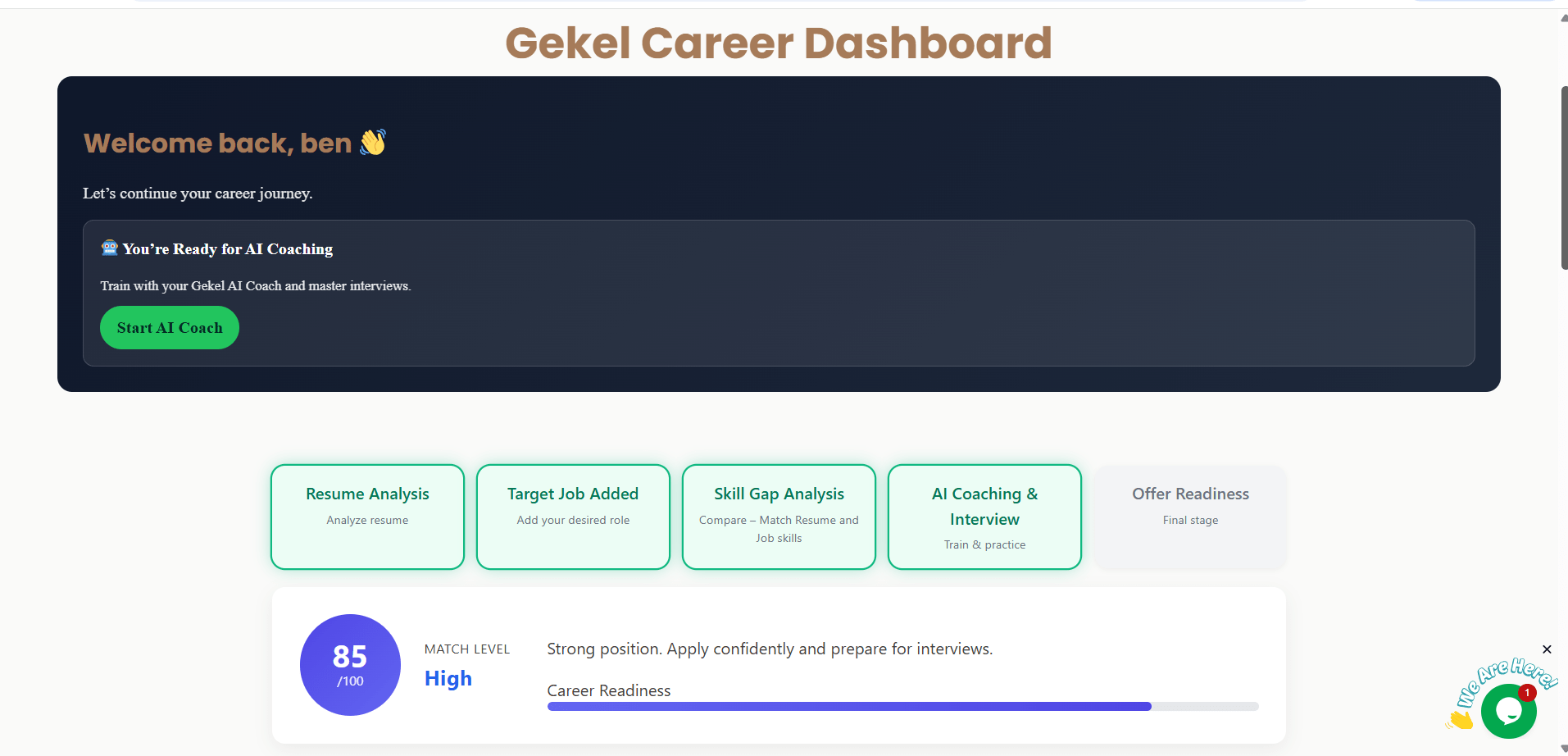
This is the foundation of the GekelEdge Career Intelligence Platform.
Resume Intelligence
The process begins with understanding the resume itself.
The goal is to identify the candidate’s professional background, experience, skills, qualifications and areas that could be strengthened.
This creates a more useful starting point than simply asking whether a resume is formatted correctly.
Target Job Intelligence
The next question is:
What does the employer actually need for this role?
A target job provides the context needed to interpret a resume more meaningfully.
Instead of evaluating the candidate against a generic idea of a “good resume,” the analysis can focus on the skills, responsibilities, experience and expectations associated with the specific opportunity.
Skill Gap Intelligence
Comparing a resume with a target opportunity can also reveal areas where the candidate may need to strengthen their position.
Some requirements may already be strongly supported by the candidate’s experience. Others may be present but poorly communicated. Some may represent genuine areas for development.
Separating these situations is important.
A missing keyword is not automatically a missing skill. Likewise, having a skill somewhere in your career history does not necessarily mean your resume communicates it effectively.
From score to action
This is where resume scoring becomes significantly more useful.
Instead of receiving a number and being left to determine what to do next, the analysis should help create a path from diagnosis to improvement.
The result is a more practical understanding of your resume’s position in relation to your career objective.
Your Resume Score Should Lead to a Better Career Decision
A resume checker becomes much more valuable when its findings help you make better decisions.
Imagine receiving a resume score that identifies several areas for improvement. The next step should not automatically be rewriting the entire resume.
First, you need to understand why those areas matter.
Perhaps the target job requires a capability that your resume does not communicate clearly.
Perhaps your experience is relevant, but your achievements are described too generally.
Perhaps the job represents a career transition and your existing experience needs to be positioned in a different way.
Or perhaps the analysis reveals a genuine skill gap that should be addressed through training, practical experience or another form of professional development.
These situations require different responses.
A useful resume analysis should help you answer:
- Am I targeting the right type of role?
- Does my resume demonstrate the value I bring?
- Which requirements do I already meet?
- Which requirements are weakly represented?
- Which gaps are genuine development areas?
- What should I improve before applying?
When a Resume Checker Is Not Enough
Automated resume analysis can provide valuable insight, but there are situations where a candidate needs more than a score and a list of recommendations.
This is particularly true when the challenge is not simply the document itself.
You are changing careers
Career transitions often require careful positioning. Your previous experience may contain transferable skills that are highly relevant to the new role, but those connections may not be obvious from a standard chronological resume.
You have repeatedly applied without results
If you have submitted numerous applications without progressing to interviews, the problem may involve more than formatting or keywords.
Your target roles, career positioning, resume messaging, application strategy or interview preparation may all need to be considered.
You are applying for a senior or highly competitive role
At more senior levels, employers may be evaluating leadership, strategic impact, scope of responsibility, commercial results and organisational influence.
Simply matching technical terms in a job description may not communicate that level of value.
You are unsure what direction to take
Sometimes the biggest career problem is not the resume. It is uncertainty about which opportunity to pursue.
In that situation, improving a resume without first clarifying the career direction can simply produce a better document for the wrong objective.
Get Personalised Career Support Beyond the Score
Sometimes the next step after analysing your resume is not another automated recommendation. You may need an experienced professional to review your positioning, understand your career goals and help you decide what to do next.
GekelEdge combines career intelligence technology with personalised professional support for people who want a deeper assessment of their career position and a practical strategy for moving forward.
Explore GekelEdge Career ServicesResume Score Checklist: What to Review Before Applying
Before submitting your next application, use the following checklist to review your resume.
The objective is not to achieve a perfect score. It is to make sure your resume presents your genuine experience clearly and is appropriately aligned with the opportunity.
If you can confidently work through this checklist, you are already approaching resume preparation in a more strategic way.
Frequently Asked Questions About Resume Scores
What is a good resume score?
There is no universal resume score that guarantees success. A score should be interpreted according to what the assessment measures and, where applicable, how closely your resume aligns with the target job. A useful score is one that helps identify strengths, weaknesses and practical improvements.
How can I check my resume score?
You can use an online resume checker or resume analysis tool to evaluate your document. For a more meaningful assessment, use a tool that allows your resume to be considered alongside the requirements of the job you want to apply for.
Is an 80 resume score good?
An 80 score may indicate a strong result within a particular scoring system, but the number should not be interpreted in isolation. Different tools use different scoring methods, and a score does not guarantee that an employer will invite you to interview.
Can my resume score change for different jobs?
Yes. If a resume is evaluated against a specific job, the result can change because different positions prioritise different skills, qualifications, responsibilities and experience. A resume can be highly relevant to one role and less relevant to another.
Is an ATS score the same as a resume score?
Not necessarily. An ATS-focused assessment may concentrate on compatibility with automated processing and the identification of relevant information. A broader resume assessment may also consider experience, achievements, skills and overall job alignment.
Are free resume checkers useful?
Free resume checkers can be useful for identifying basic issues and getting an initial assessment. However, the value depends on what the tool actually analyses and how actionable its recommendations are. A simple score without useful explanation may provide limited insight.
Can a resume score guarantee an interview?
No. A resume score cannot guarantee an interview. Hiring decisions depend on many factors beyond the resume, including the employer, role, candidate pool, qualifications, experience and recruitment process. A resume score should therefore be treated as a diagnostic and improvement tool rather than a guarantee of an outcome.
Should I add more keywords to increase my score?
Not automatically. Keywords should accurately reflect your genuine skills and experience. Adding irrelevant terms or repeatedly inserting keywords can make a resume less natural and may undermine its credibility. Focus on communicating relevant capabilities clearly.
What should I do if my resume score is low?
Start by understanding why the score is low. Review the specific findings, compare your resume with the target job description and identify whether the issue relates to formatting, missing information, weak achievement statements, skills alignment or genuine experience gaps.
Then make targeted improvements and reassess the revised resume.
Stop Guessing. Understand How Competitive Your Resume Really Is.
Instead of wondering whether your resume is strong enough, analyse it and identify the areas that could affect your competitiveness for the role you want.
Check Your Resume ScoreGet insight before you submit your next application.
About this guide
Published by GekelEdge Career Intelligence. This guide is designed to help job seekers understand resume scoring, ATS compatibility and job-specific resume alignment.
Last reviewed: September 2026
Your Resume Is More Than a Score
A resume score can give you a useful starting point, but the number itself is not the destination.
The real value comes from understanding what the score reveals about your resume, how your experience aligns with the job you want and which improvements could make your application stronger.
The best approach is therefore not to optimise your resume for a number alone.
Optimise it for relevance, clarity, credibility and the opportunity you are genuinely pursuing.
When your resume, target job and career direction are considered together, resume analysis becomes more than a simple score checker. It becomes a tool for making better career decisions.