
How to Check Your Resume Against a Job Description
Your resume may be strong and still be a poor match for the job you want. Learn how to compare your resume with a job description, identify missing skills and requirements, improve your alignment, and understand what employers and applicant tracking systems may actually be looking for.

The best way to check your resume against a job description is to compare the requirements of the role with the evidence contained in your resume. Look beyond simply counting keywords. Identify the required skills, responsibilities, qualifications, experience, tools, industry terminology, and outcomes in the job description, then determine which requirements your resume clearly demonstrates, which are only weakly represented, and which are genuinely missing.
A good resume-to-job comparison should ultimately answer one question: Does this resume clearly demonstrate why this candidate is relevant to this particular opportunity?
Why You Should Check Your Resume Against the Job Description
One of the most common resume mistakes is treating the resume as a standalone document.
Candidates often ask whether their resume is “good” without asking a more important question: Is my resume good for the job I am applying for?
Those are not necessarily the same thing.
A resume can contain strong qualifications, impressive experience, professional formatting, and relevant achievements while still failing to communicate a strong fit for a particular vacancy.
This happens because every job has a different combination of requirements.
For example, an IT support professional may have experience with Microsoft 365, Windows, hardware troubleshooting, Active Directory, networking, ticketing systems, and user support.
That same resume might perform differently when applying for:
- IT Support Specialist
- Service Desk Analyst
- IT Administrator
- Systems Administrator
- Cybersecurity Analyst
- Cloud Support Engineer
The candidate has not changed. The opportunity has.
What to Look for in a Job Description
Before comparing your resume with a job description, you need to understand what the employer is actually asking for.
Job descriptions often contain much more information than the obvious list of skills.
Look for:
- Required technical skills
- Preferred technical skills
- Years or level of experience
- Professional qualifications
- Certifications
- Software and platforms
- Industry knowledge
- Responsibilities
- Leadership expectations
- Communication requirements
- Problem-solving expectations
- Project experience
- Customer or stakeholder interaction
- Regulatory or compliance requirements
- Location or working arrangement
- Language requirements
You should also pay attention to repeated terminology. If the employer repeatedly refers to a particular technology, process, responsibility, or competency, that may indicate that it is important to the role.
How to Check Your Resume Against a Job Description Manually
You can perform a useful resume-to-job comparison yourself before using any automated resume checker.
A practical process is to work through the job description in stages.
1Read the Entire Job Description
Do not begin by immediately copying keywords into your resume.
Read the entire description first. Understand what the organisation is hiring this person to accomplish.
2Extract the Main Requirements
Create a list of the most important skills, responsibilities, qualifications, tools, experience requirements, and competencies.
3Map Each Requirement to Your Resume
For each requirement, ask whether your resume provides clear evidence that you possess it.
4Classify the Match
A simple classification can be:
- Strong match: clearly demonstrated in the resume.
- Partial match: related experience exists but is not clearly presented.
- Missing: no credible evidence exists in the resume.
- Not relevant: requirement does not meaningfully apply to your background.
5Improve the Resume Where Appropriate
Strengthen relevant experience, clarify achievements, use accurate terminology, and address genuine gaps where possible.
Separate Requirements From Preferences
Not every sentence in a job description has the same importance.
Employers may describe certain qualifications as essential, while others are desirable or preferred.
This distinction matters when deciding how closely your resume needs to match the vacancy.
This is one reason a simple keyword-counting approach can be misleading.
Compare the Required Skills
Skills are often the easiest part of a job description to identify, but they still need to be evaluated carefully.
Suppose a vacancy asks for:
- Microsoft 365
- Active Directory
- Windows troubleshooting
- Networking
- IT ticketing systems
- End-user support
Do not simply ask whether these words appear somewhere in your resume.
Ask whether your resume demonstrates how you have actually used them.
A skill mentioned in a list is weaker evidence than a skill demonstrated through professional experience.
Skills: Microsoft 365, Active Directory, Networking
Supported Microsoft 365 users across business environments, administered user accounts and access through Active Directory, and diagnosed common network connectivity and endpoint issues.
Compare Your Experience With the Job
Experience alignment is often more important than simply matching individual skills.
A job description may ask for someone who can manage incidents, support users, troubleshoot technical problems, document solutions, and work with internal teams.
Your resume should therefore make those capabilities visible through your previous work.
Look for evidence in your:
- Current role
- Previous employment
- Projects
- Technical responsibilities
- Achievements
- Certifications
- Volunteer or practical experience where relevant
You should also consider the level of responsibility.
Being familiar with a technology is different from administering it. Supporting a system is different from designing it. Participating in a project is different from managing it.
Your resume should communicate the level at which you have actually operated.
Check Keywords and Terminology
Keywords matter because employers and applicant tracking systems may use terminology from the job description when processing applications.
However, effective resume matching is not about inserting every word from the vacancy into your resume.
Instead, identify the terminology that genuinely describes your experience.
For example, an employer might use the phrase “service desk,” while your previous employer used “IT helpdesk.”
If both accurately describe your experience, your resume may benefit from using terminology that makes the relationship clear.
Check Whether Your Resume Shows Evidence
One of the most overlooked parts of resume matching is evidence.
A resume can contain all the right keywords and still fail to communicate strong professional capability.
Compare these two statements:
Provided technical support to users and resolved IT issues.
Provided first-line and second-line technical support, diagnosing hardware, software, connectivity, and account-access issues while maintaining accurate incident records and escalating complex problems appropriately.
The second statement gives a hiring manager more information about the candidate’s actual capability.
Where possible, strong resume evidence can also include:
- Scale
- Volume
- Time saved
- Cost reduction
- Performance improvement
- Project outcomes
- Customer impact
- Operational improvements
Identify Missing Skills and Requirements
A useful resume comparison should not only tell you what matches. It should also tell you what does not.
This is where resume-to-job analysis becomes more valuable than a generic resume review.
Imagine that a target role requires:
- Microsoft Azure
- PowerShell
- Microsoft 365 administration
- Endpoint management
- Active Directory
Your resume may strongly demonstrate Microsoft 365 and Active Directory experience but contain little or no evidence of Azure, PowerShell, or endpoint management.
That does not necessarily mean you should immediately abandon the application.
First determine what kind of gap exists.
Three types of gaps to consider
- Representation gap: You have the experience, but your resume does not communicate it clearly.
- Terminology gap: Your experience is similar, but the resume uses different terminology from the employer.
- Genuine skill gap: You do not currently have credible experience with the requirement.
These three situations require very different actions.
What Does a Resume-to-Job Match Score Mean?
Some resume checkers provide a score intended to show how closely a resume matches a particular job description.
Such a score can be useful as a diagnostic indicator, but it should not be treated as a guarantee of interview success.
A meaningful job-specific resume score should ideally consider more than keyword frequency.
It can consider areas such as:
- Job requirement alignment
- Required skills
- Relevant experience
- Role-specific terminology
- Qualifications and certifications
- Achievement evidence
- Missing requirements
- Potential ATS compatibility issues
- Overall career positioning
The most useful output is therefore not simply: “Your score is 72.”
The more useful question is: “Why is the score 72, what is missing, and what should I improve?”
Resume Matching vs ATS Compatibility
Resume matching and ATS compatibility are related, but they are not exactly the same thing.
An ATS-friendly resume should generally use clear formatting, readable sections, appropriate headings, and content that can be processed effectively.
But an ATS-compatible resume can still be poorly aligned with a particular job.
A strong application needs all three dimensions to work together.
How to Improve Your Resume Match
Once you have compared your resume with the job description, turn the analysis into action.
1. Strengthen relevant experience
Make important responsibilities and achievements easier to identify.
2. Use accurate job-relevant terminology
Where your existing experience genuinely matches the employer’s terminology, make that relationship clear.
3. Improve weak achievement statements
Replace vague descriptions with evidence of what you actually accomplished.
4. Address representation gaps
If you already possess a required capability but your resume hides it, improve the relevant section rather than trying to acquire something you already have.
5. Address genuine skill gaps honestly
Where a requirement is genuinely missing, consider whether you can build the skill through training, certification, practical projects, or professional experience.
6. Remove unnecessary information
More content does not automatically create a stronger application. Irrelevant information can make important evidence harder to find.
7. Recheck the resume
After making changes, compare the revised resume against the same job description again.
Mistakes to Avoid When Matching Your Resume to a Job
Keyword stuffing
Repeating keywords excessively can make a resume difficult to read and may create an unnatural document.
Copying the job description
Your resume should describe your experience, not reproduce the employer’s vacancy.
Adding skills you do not have
This can create serious problems if you are questioned about those skills during an interview.
Focusing only on ATS keywords
Getting through an automated screening process is not the same as convincing a hiring manager that you are the right candidate.
Ignoring genuine skill gaps
A missing requirement can be useful information. It may tell you what to learn next rather than simply what to add to a document.
Using one resume for every application
A general master resume can be useful, but your application should be adapted to the specific role when appropriate.
How GekelEdge Approaches Resume-to-Job Matching
At GekelEdge, the principle is simple: a resume should be understood in the context of the career opportunity it is being used to pursue.
Instead of treating resume analysis as a single isolated score, GekelEdge connects several layers of career intelligence.
1Resume Intelligence
Understand the candidate’s existing experience, skills, qualifications, achievements, and professional positioning.
2Target Job Intelligence
Understand what the selected job requires, including skills, responsibilities, qualifications, and other important signals contained in the opportunity.
3Alignment Analysis
Compare the candidate’s existing profile against the requirements of the target opportunity.
4Skill Gap Intelligence
Identify areas where the candidate is strongly aligned, weakly represented, or genuinely missing important requirements.
5Action
Turn the analysis into practical improvement actions, resume optimisation, career development, and eventually interview preparation.
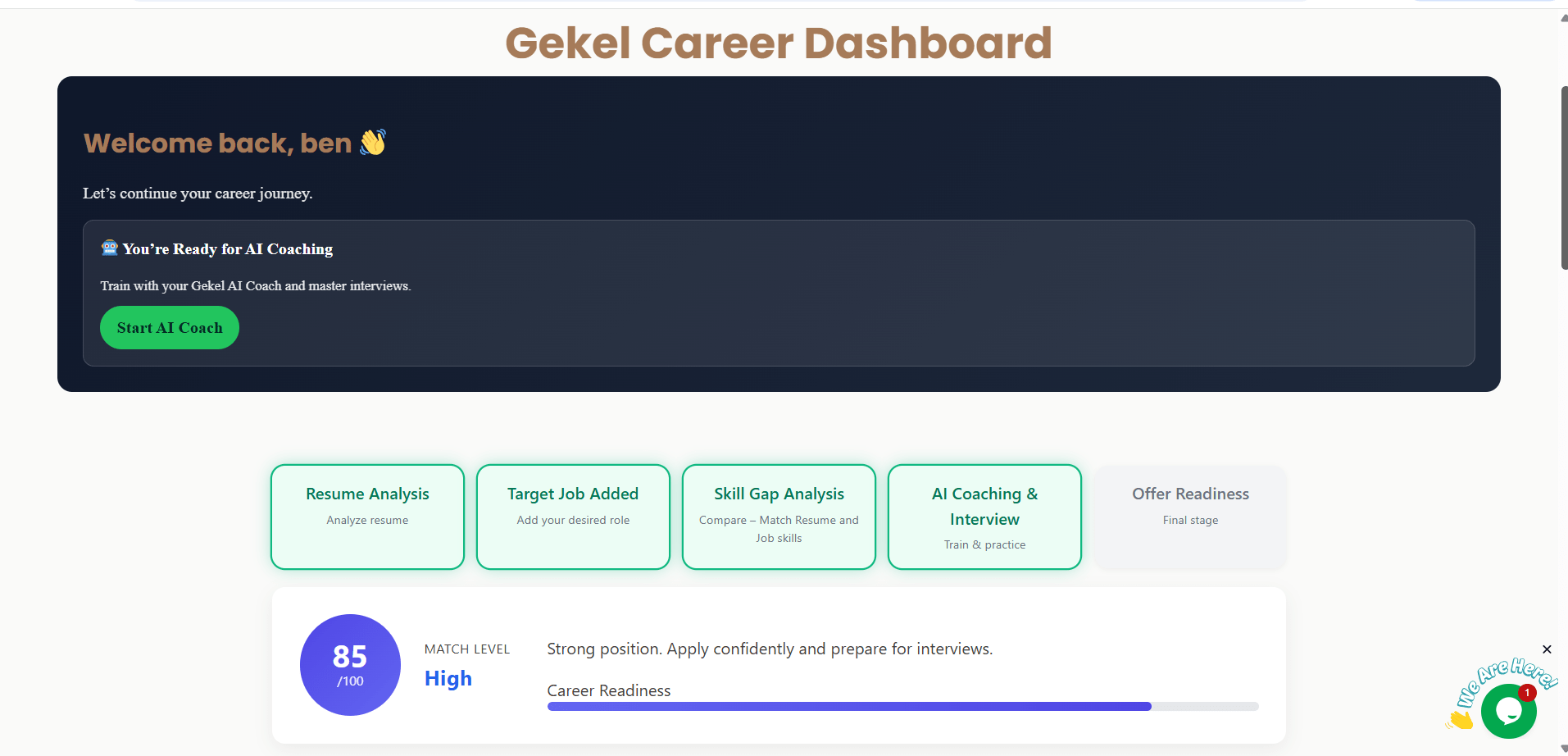
This creates a different experience from simply asking whether a resume is “good.”
The more useful question becomes: How competitive is this resume for this opportunity, why, and what should happen next?
When a Resume Checker Is Not Enough
Automated resume analysis can identify important patterns, but some career situations require human judgement.
Professional support can be particularly valuable if you are changing careers, repeatedly applying without getting interviews, targeting a competitive senior position, unsure how to position transferable experience, or struggling to understand why your applications are not converting.
GekelEdge combines career intelligence with personalised professional support to help candidates move from analysis to a practical career strategy.
You can explore personalised support through the GekelEdge Career Services programme.
Explore Career ServicesResume-to-Job Matching Checklist
Before submitting your application, work through this checklist.
Frequently Asked Questions
Extract the main skills, responsibilities, qualifications, experience requirements, and terminology from the job description, then compare each requirement with the evidence contained in your resume. Classify each requirement as a strong match, partial match, genuine gap, or not relevant.
There is no universal percentage that guarantees a good application. A strong match means your resume clearly demonstrates the important requirements of the specific opportunity while remaining accurate, relevant, readable, and credible.
Use relevant terminology when it accurately describes your experience, but avoid copying or stuffing keywords into your resume. The objective is to make genuine qualifications easier to recognise.
Yes. A resume can be professionally written and contain strong experience while still failing to demonstrate enough relevance to a particular vacancy. Resume quality and job alignment are related but different concepts.
No. ATS compatibility concerns how effectively a resume can be processed, while job matching considers how closely the candidate’s skills, experience, qualifications, and evidence align with the specific opportunity.
First determine whether the skill is genuinely missing or simply not represented clearly. If it is genuinely missing, consider whether the gap can be addressed through training, certification, projects, or practical experience. Do not claim a skill you do not possess.
You do not necessarily need to create an entirely new resume for every application. A strong master resume can provide the foundation, while targeted adjustments can make the most relevant experience, skills, achievements, and terminology more visible for each opportunity.
It can identify useful issues such as weak alignment, missing requirements, unclear evidence, or ATS-related concerns. However, no automated score can account for every hiring factor. Candidate competition, employer preferences, experience level, location, salary expectations, and the hiring process can all affect interview outcomes.
Check Your Resume Against the Job You Actually Want
Your resume should not simply describe your career. It should make the relevance of your experience clear for the opportunity you are pursuing.
GekelEdge helps you move from a generic resume review toward job-specific career intelligence — identifying alignment, highlighting gaps, and showing where improvement can make the biggest difference.
Check Your ResumeConclusion
Checking your resume against a job description is one of the most useful steps you can take before submitting an application.
It helps you move beyond the question of whether your resume looks good and toward a more important question: does my resume clearly demonstrate why I am relevant to this particular job?
Look beyond keywords. Compare skills, responsibilities, experience, qualifications, achievements, terminology, and evidence. Identify what is strongly aligned, what is poorly represented, and what is genuinely missing.
Most importantly, use the analysis to decide what to do next.
Because the strongest resume is not necessarily the one with the highest generic score. It is the one that clearly communicates the candidate’s genuine value for the opportunity being pursued.